
Understanding your muscles transforms your Wing Chun. Moreover, it gives you the knowledge to train smarter, not just harder. This guide breaks down the science and connects it directly to your practice.
Why Skeletal Muscle Matters to Your Wing Chun
Your body contains three types of muscle: cardiac, smooth, and skeletal. However, only skeletal muscle is under your conscious control. Consequently, it is the only type you can deliberately train and refine.
Skeletal muscle connects to bone via tendons. Furthermore, each muscle has an origin (its start) and an insertion (its end). Through contraction, shortening, muscles create movement around your joints.
Crucially, muscles can only pull; they cannot push. Therefore, every joint requires opposing muscles. For instance, your biceps flex the elbow, whilst your triceps extend it.
Developing precise control over skeletal muscle will noticeably sharpen your Wing Chun technique and your overall physical performance.
The Two Main Muscle Fibre Types
Skeletal muscle is made up of fibres. Broadly speaking, these fall into two categories: slow-twitch (Type I) and fast-twitch (Type II). Each type behaves differently, and both matter to you as a Wing Chun practitioner.
Genetics determines the ratio of each type in your body. Nevertheless, research now confirms that targeted training can shift this balance. In other words, your muscle composition is not fixed.
Slow-Twitch Fibres (Type I): Your Endurance Engine
Slow-twitch fibres fire more slowly than fast-twitch fibres. Yet, as a result, they resist fatigue far more effectively. They achieve this by efficiently using oxygen to generate ATP (Adenosine Tri-Phosphate), the body’s fuel.
Definition: ATP (Adenosine Tri-Phosphate) is the chemical compound your body uses to power muscle contractions.
Think about holding Yee Gee Kim Yueng Ma (the basic stance) throughout Siu Nim Tao. Indeed, it is your slow-twitch fibres in the legs and postural back muscles doing the sustained work.
Fast-Twitch Fibres (Type II): Your Explosive Power
Fast-twitch fibres contract approximately twice as fast as slow-twitch fibres. Consequently, they generate powerful, explosive bursts of speed and strength. They use anaerobic metabolism, energy production without oxygen, which means they tire quickly.
Definition: Anaerobic metabolism is energy production without the use of oxygen. It is fast but creates fatigue rapidly.
In Wing Chun, your fast-twitch triceps and biceps are vital. Specifically, they drive the rapid protraction and retraction of your punch. Furthermore, swift retraction restores your guard position immediately, ready for the next strike.
Type IIa and Type IIx: The Subtypes Worth Knowing
Fast-twitch fibres subdivide further into Type IIa and Type IIx. Understanding the difference helps you train each more effectively.
Type IIa fibres draw on both aerobic and anaerobic metabolism almost equally. As a result, they bridge the gap between endurance and explosive power. These are also called Fast Oxidative Glycolytic (FOG) fibres.
Type IIx fibres rely entirely on anaerobic metabolism. Accordingly, they contract at the highest rate of all fibre types. However, this comes at a cost: they fatigue the most rapidly and require the longest recovery.
A brief note on terminology: in older research, Type IIx was often labelled Type IIb. Subsequent research clarified that what was called ‘IIb’ in humans was, in fact, IIx. Genuine Type IIb fibres are rarely, if ever, found in human muscle.
Can You Change Your Muscle Fibre Type?
Yes — to a meaningful degree. Recent research confirms that muscle is far more adaptable than previously thought. Specifically, training can shift fibre-type characteristics in significant ways.
- Endurance training promotes a shift from fast-twitch towards slow-twitch fibre behaviour.
- Exercise activates calcium-based and AMPK signalling pathways that support slow-twitch development.
- Certain microRNAs regulate fibre-type conversion, including shifts towards faster fibres in specific conditions.
Switching between Type IIa and Type IIx is well established. Additionally, through specific training, Type IIa fibres can be developed to approach either Type I or Type IIx capabilities. Therefore, how you train directly shapes how your muscles adapt.
Muscle, Force, and the Science Behind Your Strike
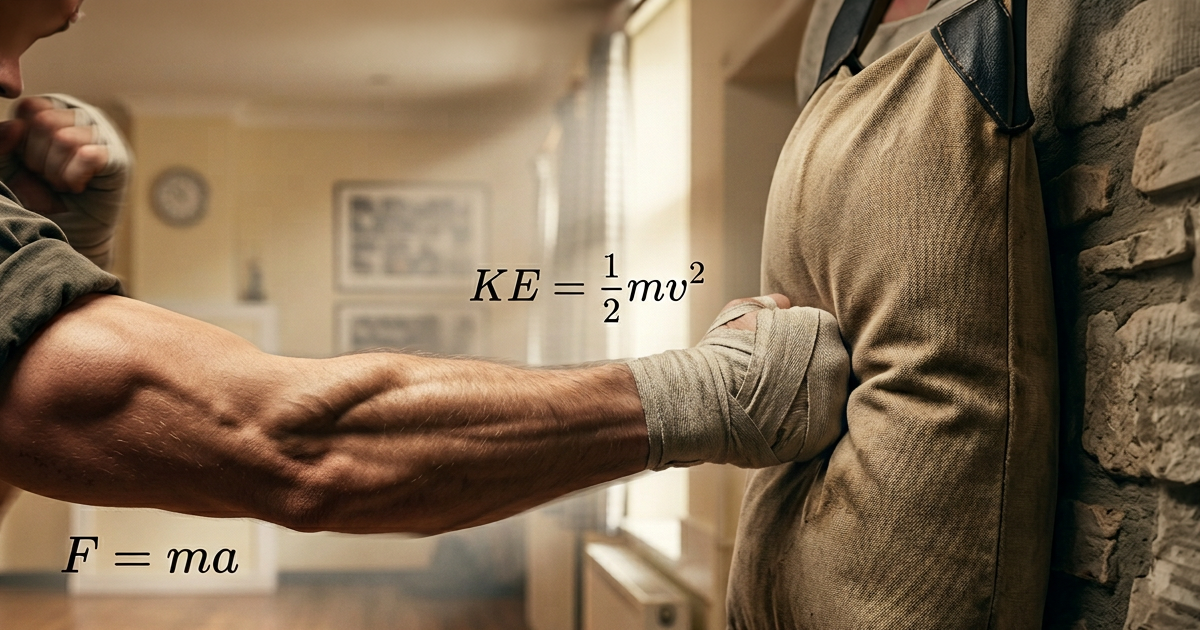
Force causes acceleration. In physics, Force = mass × acceleration. When your muscles contract to punch, they apply force to your arm, accelerating it towards the target. The faster your muscles move your arm, the greater the acceleration, and thus the greater the impact.
However, force and energy are distinct concepts. Force is an action; it is not stored energy. Instead, force creates motion, and motion carries kinetic energy.
Kinetic energy is calculated as: Ek = ½mv², where Ek is kinetic energy (in Joules), m is mass, and v is velocity. Crucially, velocity is squared. Therefore, small speed increases produce disproportionately large increases in energy.
Impact Power: Why Short Contact Time Matters
Impact Power equals Kinetic Energy divided by the Duration of contact. Consequently, the shorter the contact time, the greater the power delivered.
High power: An instantaneous stop, such as a hammer striking steel, transfers energy in a fraction of a second, producing enormous force.
Low power: A gradual stop, such as a vehicle hitting a hay bale, distributes the same energy over a longer period, dramatically reducing impact force.
This is precisely why airbags and crumple zones exist: they extend contact time to reduce force on passengers. In Wing Chun, the opposite principle applies: a clean, fast strike maximises impact power.
Ready to Put This Into Practice?
Understanding your muscle types is only the beginning. Furthermore, applying this knowledge under the guidance of an experienced instructor will accelerate your progress far beyond solo study.
Book a class or trial session today and experience how science-informed Wing Chun training transforms your technique, your power, and your understanding of the art.
► Book your trial session now and start training with purpose.