
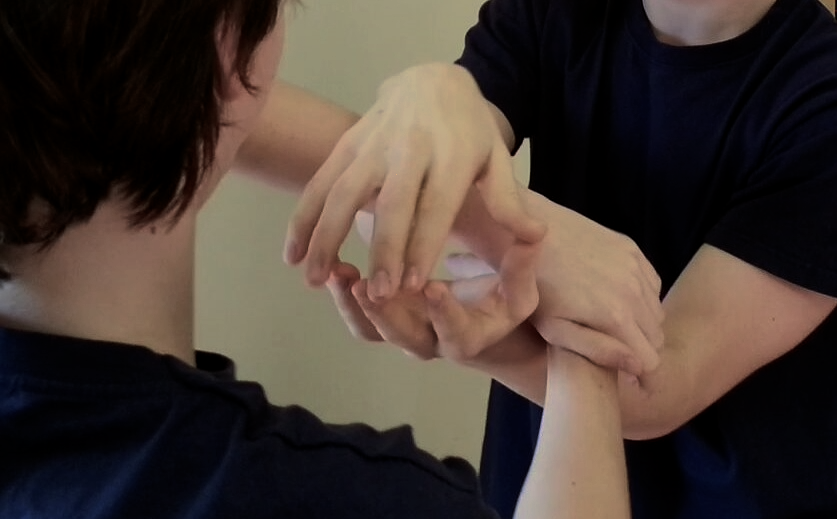
To understand Mai Jiang, study the first section of Siu Nim Tao, the Wing Chun form meaning “Little Idea.”
In this section of the form, we repeatedly practise a movement based on Fuk Sau (the controlling or bridging hand). Together, these three movements form Saam Pai Fut, meaning “praying three times to Buddha”.
Although the hand moves forward, the real focus of the movement should be on the elbow, not the wrist. This is where the principle of Mai Jiang comes in. Mai Jiang means to focus the elbow inward and forward. You should perform the movement with relaxation, allowing precision to come from mindful movement. This is a key to developing Nim Lik (mind force).
When you do this correctly:
- The elbow presses gently towards the centre line and forward.
- The hand travels forward in a straight line from the centre.
- The wrist finishes just below throat height, regardless of whether you are in the Tan Sao or Fook Sao cycle.
- The elbow does not need to stay on the centre line. The aim is to gently guide the medial epicondyle inwards.
- Forward movement stops when the elbow tip (olecranon) is about a fist to a fist-and-thumb away from the chest.
This creates a strong, balanced structure relying on knowledge of arm position rather than arm strength.
Why Repetition Matters
Repeating this movement trains your body to remember the start and end positions, and the path between them. Over time, this builds muscle memory, allowing your body to return to the correct structure automatically, without conscious effort.
Retract the elbow and bring it back to a relaxed position alongside the ribcage, finishing almost directly beneath the shoulder. This moves the hand into Wu Sau (protective hand), one to one-and-a-thumb fist-width in front of the chest, on the centreline.
Important: You return the hand to its starting position by carefully flexing the elbow and extending the shoulder.
In Siu Nim Tao, you practise this movement at least three times. In personal training, you can repeat it as often as you like to reinforce good habits.
What Mai Jiang Teaches Us
This section of Siu Nim Tao teaches the importance of combining inward and forward intent. This helps to develop Gung Lik — the energy built through correct, consistent practice.
Pressing forward only can push your elbow wide, even beyond the body’s centreline. This is not necessarily incorrect in application, but it is if you do not know it is happening!
Pressing inward only can cause you to lose focus on the opponent, slowing your response and weakening your strikes.
By training the concept of Mai Jiang correctly, you become more aware of where your elbow is at all times. This gives you early feedback when your structure is out of position, so you can adjust quickly and efficiently.
Bringing It All Together
Mai Jiang is a vital Wing Chun principle. Applying it well will improve your structure, balance, and control.
However, it is only one of many Wing Chun principles. To truly develop skill, we must practise and balance all of these principles, so they work together. Over time, this allows each practitioner to shape a style that suits their own body, ability, and goals.
Consistent, mindful training is what unlocks the real power of Wing Chun.
Reading about Wing Chun is one thing, and practising it is another. Want to experience these ideas firsthand? Message The Wing Chun Collective and book your first free session today!